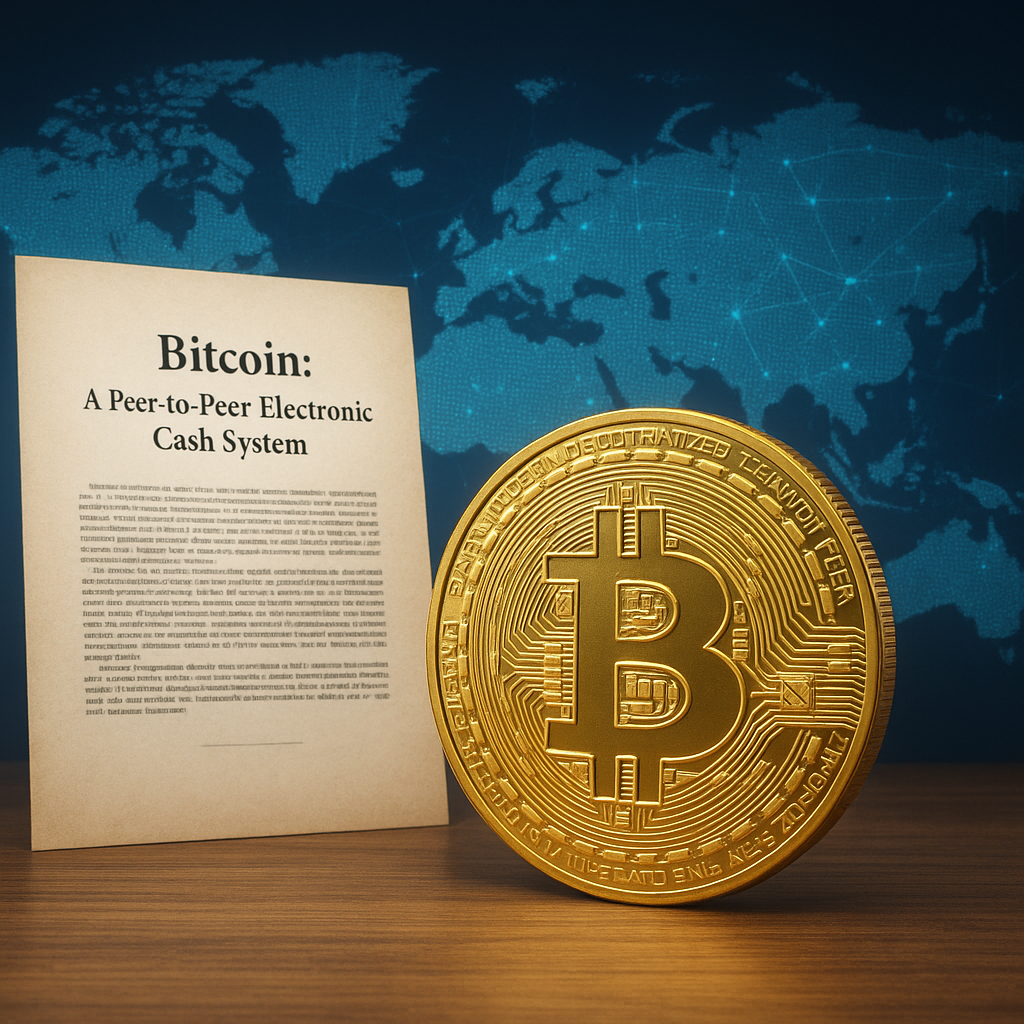
Cryptocurrencies represent one of the most transformative developments in modern finance, challenging traditional paradigms and offering new pathways for value transfer. This article explores the journey from the publication of the seminal Bitcoin whitepaper to the emergence of a thriving ecosystem of digital assets, protocols, and decentralized applications. Through an examination of key milestones, technological breakthroughs, and evolving regulatory landscapes, readers will gain insight into the forces shaping the future of money and finance.
Origins of Bitcoin and the Whitepaper
In October 2008, an individual or group operating under the pseudonym Satoshi Nakamoto released a nine-page document titled “Bitcoin: A Peer-to-Peer Electronic Cash System.” This whitepaper laid out the blueprint for a novel form of digital currency that solved the longstanding double spending problem without relying on centralized authorities. By combining cryptographic proof with a decentralized ledger—the blockchain—Bitcoin offered participants a way to transact securely and transparently.
The core innovations described in the whitepaper included:
- Proof-of-Work consensus to secure the network and deter malicious actors
- A chain of timestamped blocks containing transaction data
- A reward mechanism for miners, incentivizing the validation of new blocks
When the first block—known as the genesis block—was mined on January 3, 2009, it carried a hidden message referencing a newspaper headline on bank bailouts, signaling a critique of the traditional banking system and highlighting Bitcoin’s vision of decentralization.
Early Adoption and Challenges
During its infancy, Bitcoin attracted a small but passionate community of cryptographers, libertarians, programmers, and enthusiasts drawn to its promise of a borderless currency. Initial transactions were modest, with Bitcoin units trading for fractions of a penny. However, as interest grew, several challenges emerged:
- Security vulnerabilities in fledgling exchanges and wallets
- Regulatory uncertainty in various jurisdictions
- Association with illicit markets, most notably the Silk Road marketplace
One of the earliest and most infamous events was the collapse of Mt. Gox in 2014, which had been handling over 70% of global Bitcoin transactions. The exchange’s security lapses and alleged mismanagement shook investor confidence but also prompted stronger emphasis on security standards and best practices. Over time, more robust wallet solutions, multi-signature addresses, and hardware devices emerged to protect users’ holdings.
Technological Innovations and Altcoins
As Bitcoin’s popularity increased, developers began exploring new directions, creating alternative cryptocurrencies—or altcoins—that experimented with different consensus mechanisms, block times, and feature sets. This period of rapid innovation paved the way for a more diverse ecosystem.
Smart Contracts and Ethereum
In 2015, Vitalik Buterin launched Ethereum, a blockchain platform designed to support programmable logic in the form of smart contracts. This breakthrough enabled developers to build decentralized applications (dApps) across finance, gaming, supply chain, and beyond. Key characteristics of smart contracts include:
- Self-execution upon predefined conditions
- Immutable code stored on the blockchain
- Removal of intermediaries in financial and legal agreements
Ethereum’s introduction marked a shift from simple currency transfers to complex on-chain logic, inspiring thousands of projects and spawning the phenomenon known as decentralized finance.
Scaling Solutions
With growing network usage came concerns over transaction speed and costs. To address these limitations, researchers and developers proposed various scaling solutions:
- Layer 2 protocols like the Lightning Network for Bitcoin, enabling near-instant, low-cost payments
- Sharding and rollups for Ethereum, splitting data processing across multiple chains or batches
- Alternative consensus mechanisms such as Proof-of-Stake to reduce energy consumption
These innovations continue to evolve, improving throughput while preserving the core principles of security and decentralization.
Regulation and Institutional Interest
As the market capitalization of cryptocurrencies surged into the hundreds of billions of dollars, traditional financial institutions and corporations took notice. High-profile developments included:
- CME and CBOE launching Bitcoin futures products
- Major payment processors integrating digital asset services
- Publicly traded companies allocating treasury reserves to Bitcoin
Simultaneously, regulators worldwide struggled to balance innovation with consumer protection. The U.S. Securities and Exchange Commission (SEC) debated the classification of tokens as securities, while other jurisdictions crafted licensing regimes for exchanges and custodians. This patchwork of rules has influenced where and how projects can operate, underscoring the importance of compliance and legal clarity.
Decentralized Finance and Beyond
Decentralized finance, or DeFi, represents a new frontier in which financial instruments—lending, borrowing, derivatives, insurance—are executed on open blockchains. Without intermediaries, users can:
- Earn interest by supplying assets to liquidity pools
- Obtain loans by posting cryptocurrency collateral
- Trade assets on decentralized exchanges (DEXs) with automated market makers
Simultaneously, the rise of non-fungible tokens (NFTs) has demonstrated the versatility of blockchain for digital art, collectibles, and virtual real estate. Brands, artists, and gamers have embraced NFTs as a new medium for creativity and monetization.
Looking ahead, the convergence of DeFi, NFTs, and emerging concepts like the metaverse promises to redefine ownership, identity, and economic interaction in the digital realm. Projects are experimenting with cross-chain interoperability, privacy-preserving protocols, and on-chain governance to further align blockchain networks with the principles of transparency and user empowerment.
Future Perspectives
The trajectory of cryptocurrencies and blockchain technology suggests ongoing evolution rather than a fixed destination. Key areas of focus for the coming years include:
- Enhanced privacy solutions balancing confidentiality with regulatory oversight
- Central bank digital currencies (CBDCs) coexisting with decentralized alternatives
- Broader financial inclusion in underbanked regions through mobile access to digital assets
Ultimately, the story that began with the 2008 whitepaper continues to unfold across global markets, technological landscapes, and societal norms. The interplay of innovation, regulation, and community-driven development will determine whether cryptocurrencies achieve mainstream adoption as transformative tools for the 21st century.